Moving Load Analysis Simulator – Free Online Beam Analysis Tool
Analyze the effect of moving vehicle loads on structural beams using this free online Moving Load Analysis Simulator. Visualize how moving axle loads affect support reactions, Shear Force Diagram (SFD) and Bending Moment Diagram (BMD) in real time.
This interactive structural engineering tool helps civil engineering students, structural engineers and bridge engineers understand the behaviour of beams subjected to moving loads.
Adjust beam dimensions, material properties, vehicle axle loads and animation speed to observe how structural responses change as the vehicle travels across the beam.
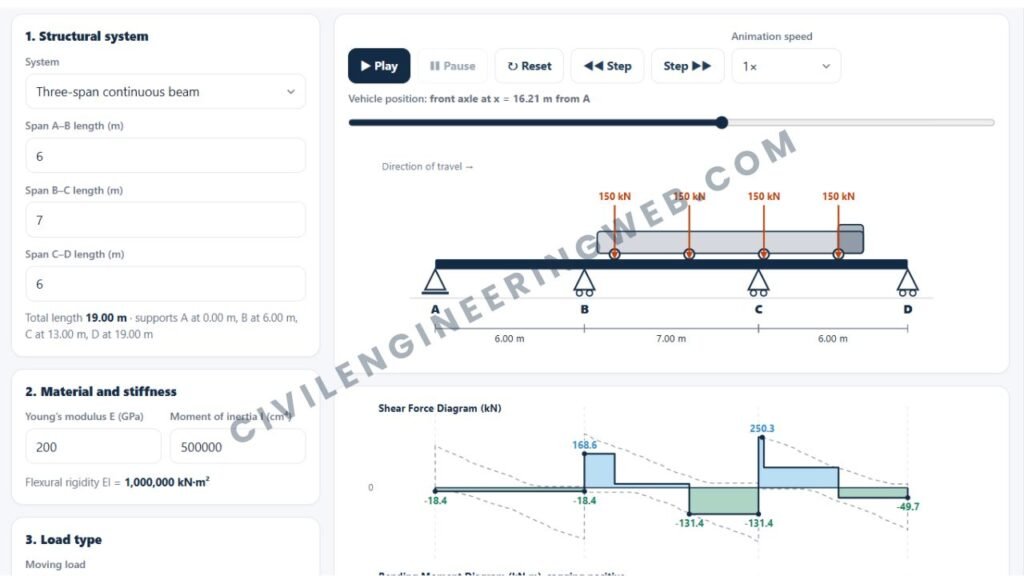
Key Features of the Moving Load Analysis Simulator
- Interactive Beam Visualization: View the beam, supports, vehicle position and moving axle loads.
- Moving Vehicle Simulation: Simulate vehicle movement across the beam using animation controls.
- Custom Beam Configuration: Define beam spans and structural system parameters.
- Material and Stiffness Inputs: Enter Young’s modulus and moment of inertia to define flexural rigidity.
- Shear Force Diagram (SFD): Visualize changes in shear force as the vehicle moves.
- Bending Moment Diagram (BMD): Observe the bending moment distribution along the beam.
- Support Reactions: Monitor support reactions under different vehicle positions.
- Simulation Controls: Play, pause, reset and manually adjust vehicle position.
- Real-Time Results: Observe changes in structural response during the simulation.
What is Moving Load Analysis?
Moving load analysis is a structural analysis method used to determine the effects of loads that change their position along a structure.
Unlike fixed loads, moving loads travel across the structural member and produce different values of shear force, bending moment and support reactions at different positions.
Moving load analysis is particularly important in the design of bridges, railway structures, crane girders and other structures subjected to moving vehicles or equipment.
For example, when a train moves across a railway bridge, the position of each axle changes continuously. This causes variations in the internal forces developed in the bridge structure.
Engineers perform moving load analysis to identify critical load positions and determine the maximum structural effects.
How to Use the Moving Load Analysis Simulator
Follow these steps to perform an interactive beam analysis:
- Select the Structural System: Choose the required beam configuration.
- Enter Beam Dimensions: Specify the span length and other geometric parameters.
- Define Material Properties: Enter Young’s modulus and moment of inertia.
- Configure Moving Loads: Select the load type and define vehicle axle loads and spacing.
- Start the Simulation: Click the Play button to move the vehicle across the beam.
- Observe Structural Responses: Monitor support reactions, SFD and BMD as the vehicle changes position.
- Control the Simulation: Use the pause, reset, step and speed controls to study different load positions.
Applications of Moving Load Analysis
Moving load analysis is commonly used in:
- Railway bridge design.
- Highway and road bridge design.
- Crane girder and gantry structures.
- Industrial structures with moving equipment.
- Railway track supporting structures.
- Structures subjected to moving heavy vehicles.
Frequently Asked Questions
1. What is a moving load analysis simulator?
A moving load analysis simulator is an interactive engineering tool that calculates and visualizes the structural response of beams subjected to loads that change position. It helps engineers study support reactions, shear forces and bending moments.
2. What is the difference between fixed load analysis and moving load analysis?
In fixed load analysis, the loads remain at specified positions on the structure. In moving load analysis, the load positions change, resulting in different structural responses at different stages.
3. What are SFD and BMD?
SFD stands for Shear Force Diagram, which represents the variation of internal shear force along a structural member. BMD stands for Bending Moment Diagram, which represents the variation of internal bending moment along the member.
4. Why is moving load analysis important in bridge design?
Moving load analysis helps engineers identify critical vehicle positions that produce maximum shear forces, bending moments and support reactions. These results are important for evaluating bridge structural requirements.
5. Can moving load analysis be performed for continuous beams?
Yes. Continuous beams can be analyzed under moving loads using structural analysis methods such as the direct stiffness method or finite element method. The analysis must account for continuity and support boundary conditions.
6. Who can use this online moving load simulator?
Civil engineering students, structural engineers, bridge engineers and engineering educators can use the simulator to understand the behavior of beams under moving loads.
Engineering Disclaimer
This simulator is intended for educational and conceptual understanding of moving load analysis. Results should be independently verified before being used in professional structural design. Always refer to applicable design standards, loading codes and approved engineering software for actual projects.